
General
What does product development cost? A fixed price in two phases instead of open hourly billing
What do product development and prototyping cost? What the costs depend on, why KANID works with two fixed prices, and how instalments and the partner model work.
“What does it cost to have a product developed?” is the question I get most often — and the one for which you most rarely find a concrete answer online. Usually it is “it depends”. That is true, but it does not help.
So here is both: what the costs depend on, and what product development at KANID actually costs.
What the costs depend on
The costs of a product development hang mainly on four things:
- Complexity: A single part is something else than an assembly with moving parts, electronics or seals.
- Maturity of the idea: Is there already a requirements specification, sketches or a functional sample — or only the idea?
- Number of test loops: Every prototype, every change costs time and material.
- Requirements for manufacture: Depending on the process and the quantity, the effort of design for manufacture in CAD changes.
That is exactly why a serious cost estimate for the whole development is hardly possible at the start. Anyone who nevertheless already names a fixed price for everything has to include a large risk surcharge or renegotiate later. A concrete cost estimate for phase 2 only arises with the concept: after phase 1 you receive a binding fixed-price quote.
The problem with hourly billing
The alternative, billing by the hour, shifts the risk to you. Every unclear requirement and every extra loop lands on the invoice. At the start nobody knows where the total will end up — neither you nor the developer.
I do not consider either of those fair. That is why I work in two steps, both at a fixed price.
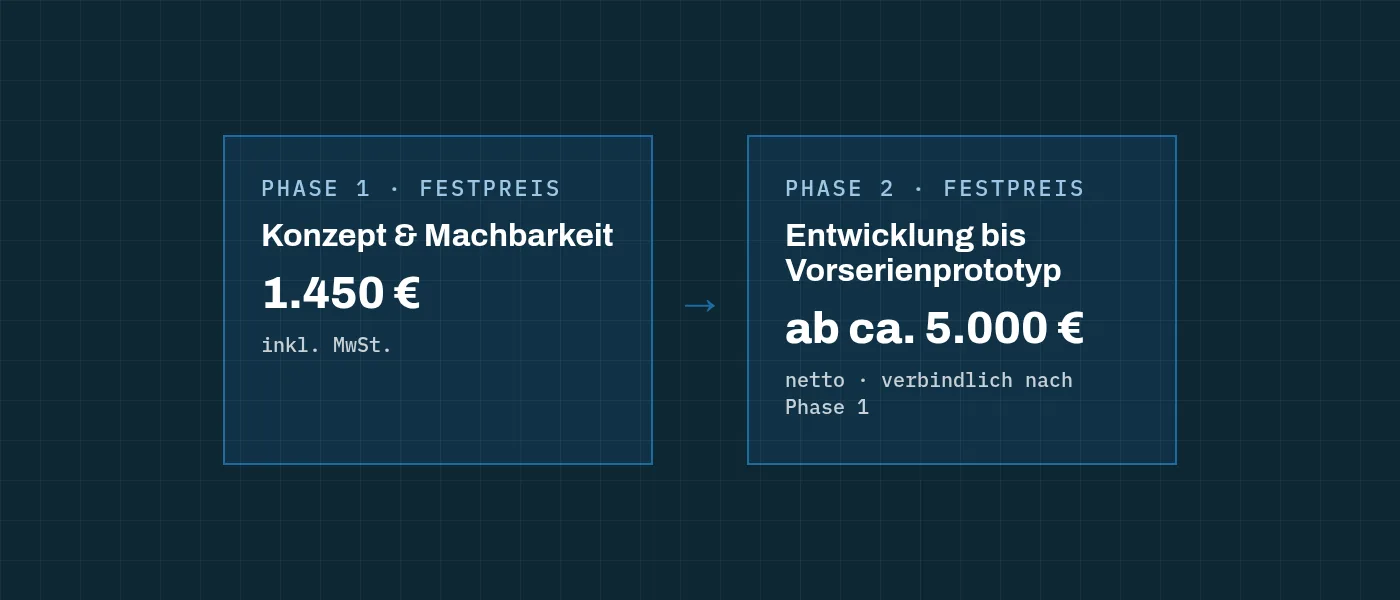
Step 1: Concept & feasibility — 1,450 € fixed price
Phase 1 clarifies whether and how your idea works, before design begins. It costs 1,450 € incl. 19% VAT (1,218.49 € net) and takes about 3–4 weeks.
The result:
- Requirements specification (Lastenheft)
- Solution concept and sketches
- Parts list with sources of supply
- Short report on risks
- Binding fixed-price quote for phase 2
The last point is the most important: after phase 1 you know what the implementation costs, before you commission it. You then decide whether to continue.
Step 2: Development through to the pre-series prototype — a fixed price after phase 1
Phase 2 is also a fixed price. It is quoted as binding on the basis of phase 1. As a guide:
- Companies: from about 5,000 € net plus VAT
- Private individuals: from about 5,950 € incl. 19% VAT
Included in the fixed price:
- CAD in Onshape with review via a link in the browser
- 3D-printed prototypes from our own workshop, including prototype material as quoted
- 2 revision loops
- FEM where needed
- Drawings, bill of materials and STEP data
- Tests and the pre-series prototype
What happens in the individual steps I describe in the post From the idea to the product.
An example for orientation
An anonymised example project — a mechanical assembly for an inventor’s product — came to about 8,700 € net including material (about 10,353 € incl. 19% VAT) and took about 12 weeks. That is an example, not a guide value for your project. Your price is in the fixed-price quote after phase 1.
What is not in the fixed price
Extra work and further revision loops beyond the two included ones only come after your prior approval. For that, an hourly rate of 120 € net plus VAT applies for companies, or 142.80 € incl. 19% VAT for private individuals. Without your approval, no additional costs arise.
Also not included are the costs after the pre-series prototype: tools, series production, tests, certifications. Those depend on the product, and with the data from phase 2 you obtain quotes for them from manufacturers.
Payment: instalments or the partner model
Path A: Fixed price in three instalments
You pay the fixed price for phase 2 in three instalments:
- Companies: at the start, after the first prototype, and on acceptance.
- Private individuals: the first instalment only after handover of the first CAD status, the second after the first prototype, and the third on acceptance. So you always pay only when a status is available.
Path B: Partner model
For companies and founders who want to market the product commercially and have a tight budget, there is the partner model. In phase 2 you pay only material and external costs up front. In return, KANID receives a time-limited share of revenue after market launch.
The terms are agreed individually and in writing after we have reviewed the project. There are deliberately no fixed percentages, because every product and every market is different. The partner model is not intended for private individuals.
Check funding
For small and medium-sized enterprises with their headquarters in Baden-Württemberg (and start-ups there) there is the state’s innovation voucher (Innovationsgutschein). It subsidises external R&D services in innovative projects; contract work/developments and standard industry design services are not eligible for funding, according to the L-Bank information sheet. Whether a project is funded is decided by L-Bank. Important here: the assignment is placed only after receipt of the grant notice. The details are in the post Innovation voucher Baden-Württemberg.
In brief
What does product development cost at KANID?
Phase 1 (concept & feasibility) costs 1,450 € incl. 19% VAT (1,218.49 € net) as a fixed price. Phase 2 through to the pre-series prototype is also a fixed price, quoted as binding after phase 1; as a guide, from about 5,000 € net plus VAT for companies, or from about 5,950 € incl. 19% VAT for private individuals.
Do I get a cost estimate in advance?
Yes. Phase 1, concept and feasibility, costs a fixed 1,450 € incl. 19% VAT (1,218.49 € net). The fixed price for phase 2 is set after the concept: it is quoted as binding on the basis of phase 1, before you commission the development.
What does prototyping cost at KANID?
At KANID, prototyping is part of the development in phase 2: 3D-printed prototypes from our own workshop, prototype material as quoted, and 2 revision loops are included in the fixed price. As a guide, phase 2 starts from about 5,000 € net plus VAT for companies, or from about 5,950 € incl. 19% VAT for private individuals. For a print job only, without development, send a short enquiry via the contact form. How the prototypes are made is in the post Having a 3D-printed prototype made.
Why no hourly rate?
Because a fixed price can be planned. Extra work and further revision loops only with your prior approval.
How is phase 2 paid?
In three instalments. Companies pay at the start, after the first prototype, and on acceptance. Private individuals pay the first instalment only after the first CAD status, the second after the first prototype, and the third on acceptance.
Who is the partner model for?
For companies and founders who will market the product commercially. In phase 2 they pay only material and external costs up front; in return, KANID receives a time-limited share of revenue after market launch. The terms are agreed individually and in writing after we have reviewed the project.
Conclusion
Product development does not have to be an open budget. At KANID you first pay a small fixed price for concept and feasibility and then decide, with a binding fixed price, whether to continue. All prices and conditions are under Services, the contractual terms in the terms for business customers and the terms for consumers. For your project, write to me via the contact form.
product development costshaving a product developedfixed priceprototype costsprototyping costspartner model